
Programmes for the Ascent
Debate and public speaking, taught by the coach who twice led Pakistan at the World Schools Debating Championship. Choose a programme below, or book a free consultation and we will recommend the right one.

WSDC Debate
For new debaters and for students already competing
View the programme →

World Scholar’s Cup
For students heading to a Cup round
View the programme →

1:1 Coaching
One student, one coach, in debate or speaking
View the programme →

Public Speaking
Confidence, not competition
View the programme →
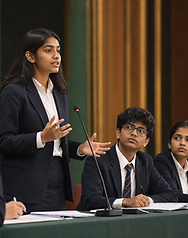
WSDC Debate: the world schools format
Three-a-side debating in the format used at the World Schools Debating Championship. Students learn to build arguments that hold up under rebuttal, think quickly on their feet and stay composed when the other team presses.
The course runs as three levels. Each student starts at the level recommended in the free consultation, and moves up when the end-of-term report shows they are ready.
Ages 11–18 · One 2-hour session a week · 12-week terms · Live on Zoom · A student handbook for every session
Level 1 of 3 · Beginner
Find Your Voice
For students new to competitive debate, or with some school debating.
▰▱▱
By the end, your child can
◆ build an argument with a clear claim, reasons and real examples
◆ tell a moral argument from a practical one
◆ answer an opponent calmly
◆ debate a full round in a team of three
10–15 students
Level 2 of 3 · Intermediate
Command the Room
For students who have finished Beginner, or whose skills check shows they can build a sound argument. Suits those preparing for school, national or international tournaments.
▰▰▱
By the end, your child can
◆ show step by step how and why people will act as claimed
◆ prepare as a team in one hour, without devices
◆ give every speech, including the closing reply
◆ research a theme for unseen motions (debate topics)
8–12 students · Most students take two terms
Level 3 of 3 · Advanced
Take the World Stage
For students who already debate well in World Schools style and are aiming at national selection and international tournaments.
▰▰▰
By the end, your child can
◆ choose what to answer, and what to leave
◆ find the single idea a case rests on
◆ weigh a likely benefit against a certain harm
◆ run a full one-hour prep and hold the plan when the round turns
6–10 students · Written feedback after every debate
Not sure of the level? The free consultation will recommend one.

World Scholar’s Cup: for scholars headed to the Cup
Focused training for the Cup’s Team Debate: the format, the judging and the season’s theme. No experience needed. Join as a team, or alone and we place you in one. The block ends two to three weeks before your round, and each team leaves with a written plan for the weeks in between.
Every division, from Skittles to Senior · One 2-hour session a week for 8 weeks · 8–15 students · An end-of-course report for parents
By the end, your child can
◆ plan as a team in 15 minutes
◆ answer the other side calmly
◆ use the theme curriculum and the news as evidence
◆ judge a debate and give helpful feedback
How the eight weeks run
Weeks 1–2
Building arguments, first practice debate
Weeks 3–6
Speaker roles, answering, the theme as evidence, judging
Weeks 7–8
Mock tournament and a final
1:1 Coaching: one student, one coach

Every hour built on what your child actually needs, in debate or in public speaking.
A written development plan within 48 hours of the first session. A progress report for parents every four sessions. Sessions are scheduled around the student.
Private sessions on Zoom, for any age
Public Speaking: a stage, not a scoreboard
For students who want confidence in class, in assemblies, in interviews and on camera. No experience needed, and no debates or teams. Every student speaks in every session, from 30 seconds in week 1 to three minutes by the end.

One 2-hour session a week · 12-week term · 10–15 students
By the end, your child can
◆ make a point with reasons, an example and why it matters
◆ speak from short notes with steady pace and eye contact
◆ speak with one minute’s preparation and answer questions
◆ speak well on camera
How the twelve weeks run
Weeks 1–4
Natural style, making a point
Weeks 5–7
Audience, voice and body, stories
Weeks 8–11
Persuasive, on-the-spot and on-camera speeches
Week 12
Showcase. Families welcome.
In every group course, the same standard
◆ Live on Zoom, in small groups, cameras on.
◆ The same shape every session: warm-up, one new skill, practice, feedback.
◆ Feedback after every debate or speech: what worked, what cost them, one fix for next time.
◆ A skills check in the first and last session, and a written report within a week that recommends the next course.
◆ AI may help find research questions and sources. It never writes a student’s arguments, rebuttals or speeches.